 Orca finance
Orca finance is Solana liquidity management from deposit to close
Orca finance is the process of opening an Orca Whirlpools position on Solana, reading its token composition, changing deposited liquidity and ending it through an authorized position closure. A deposit assigns liquidity between two price bounds and mints a position NFT. The balance then changes as swaps move the pool price through that range. A full withdrawal returns the position's tokens, while closure additionally empties fee and reward balances and burns the NFT.
Key takeaway: It is Solana concentrated-liquidity management for deposits, range tracking, adjustments, and full withdrawal versus NFT-burning closure.
A deliberate entry for active Solana liquidity providers
An Orca Whirlpools deposit turns a chosen token amount and price range into one managed on-chain position. The Liquidity Terminal calculates the required second asset after the user selects a pool, a lower bound and an upper bound. Phantom, Solflare and Backpack can sign the resulting Solana transaction, provided the wallet holds the two required assets and enough SOL for execution.
The core opening sequence uses two position actions on Solana. The open-position action creates a 216-byte Position account at 0 liquidity, defines two tick boundaries and mints the authority token. The increase-liquidity action then transfers token A and token B into the Whirlpool vaults. When a boundary's tick array does not exist, initialization adds another account-creation step. A classic SPL Token position mint has 0 decimals, and its token account must hold exactly 1 unit. Token-2022 positions use the newer token program and its metadata extensions.
One NFT therefore maps to one ordinary position, even after its deposited amounts change.
For a SOL/USDC position, entering an amount on one side lets Orca calculate the other side from the chosen bounds and current pool price. A range containing the current price requires both SOL and USDC. A range entirely on one side of the price opens with a single asset, preserving the chosen directional setup after confirmation.
What does an Orca position balance actually show?
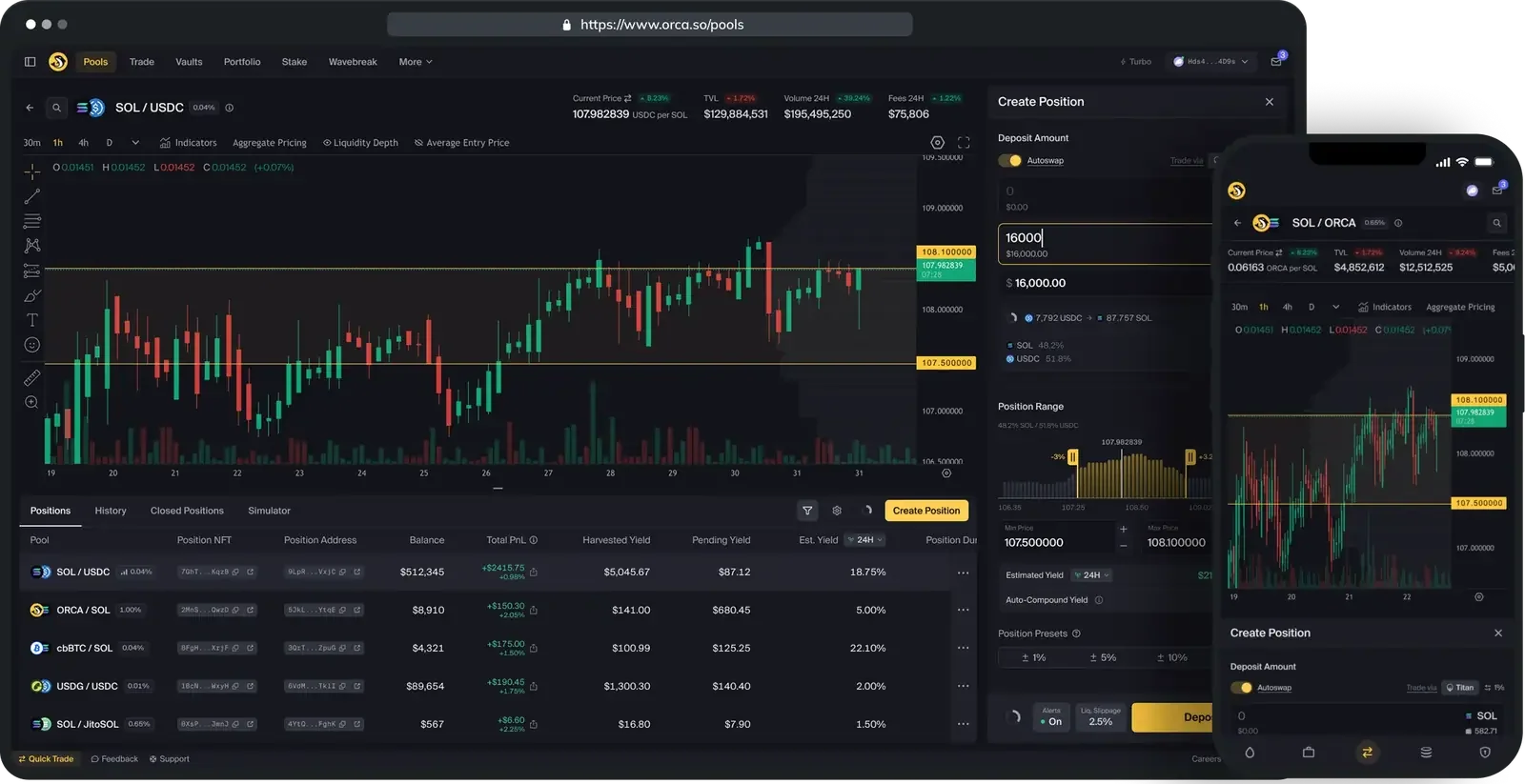
An Orca position balance reports the two token amounts represented by liquidity at the pool's current price. It is a live composition, not a record of the original deposit. The Position Details view pairs those amounts with the lower bound, upper bound, current price and an in-range or out-of-range status.
The on-chain Position account keeps one liquidity value, two fee-owed counters and three reward slots alongside its two ticks. Orca's interface translates those accounting fields into token balances and pending yield. In range, both assets normally appear because trades move through the active liquidity. Below one boundary or above the other, the mathematical inventory shifts toward a single asset. The balance therefore answers two separate questions: how much liquidity remains and which tokens the position would release if reduced at that pool price. That distinction matters before any withdrawal (see also Orca finance walkthrough ).
Pending yield stays separate until collection, so a displayed position balance and a wallet balance describe different accounts.
Out-of-range exposure arrives before closure
Out-of-range status changes the position's token composition and pauses fee earning until the price re-enters the bounds. The Whirlpool remains open, and its NFT still controls deposits, withdrawals and collections. Each tick moves price by one basis point through a 1.0001 ratio, across indexes from -443636 to 443636. Crossing the lower or upper tick converts the active liquidity toward one side; beyond the range, the position represents 100% of one token. Returning inside the same two bounds resumes active liquidity.
Can you resize liquidity without replacing the position NFT?
An Orca position can grow or shrink without changing its range or creating another position NFT. Deposit Liquidity invokes an increase, while Withdraw Liquidity invokes a decrease. Both actions retain the same Whirlpool, two tick boundaries, position address and one-unit authority token.
Adding funds uses the ratio required by the existing range at the current price. Orca's Autoswap option can exchange part of a wallet balance before depositing when the available assets do not match that ratio. A partial withdrawal follows the opposite path: the program reduces liquidity and returns the corresponding token A and token B amounts. Selecting Max requests a 100% reduction, but keeping the NFT leaves the empty position available for the same range.
Changing the two bounds is a separate adjustment. The Whirlpool program's reset-position-range instruction requires all six tracked claims to read zero: the liquidity value, two fee balances and three reward balances. It then writes a different valid lower tick and upper tick to the same empty position. Tooling built with the Orca Whirlpools TypeScript SDK or Rust SDK decides whether to expose that protocol-level transition.
The decision checkpoint before every adjustment
A sound Orca finance adjustment starts by matching the intended action to the position's current state. Five concrete checks separate a routine resize from a range reset or final closure.
- Leave liquidity unchanged when the pool price remains inside both bounds and the present token mix still matches the intended exposure.
- Add liquidity only when the same Whirlpool, fee configuration and two existing boundaries remain suitable for the new capital.
- Withdraw part when exposure should fall but the existing range and one position NFT should remain active.
- Empty every tracked balance before resetting two boundaries, including fees for both pool tokens and as many as three reward balances.
- Burn through Close Position only after deciding the exact range will not be reused with the retained NFT.
The fee-paying wallet must also keep SOL outside the deposit. Solana divides 1 SOL into 1,000,000,000 lamports, while the wallet preview states the transaction's actual charge. That reserve matters during every signed change, even when the position itself contains two non-SOL SPL tokens. Range alerts provide a useful trigger for this checkpoint because an out-of-range notification identifies a composition change rather than a forced exit.
When does a full withdrawal become a closed position?
A full withdrawal removes 100% of liquidity, while closing also destroys the empty position account and its authority token. Orca's Withdraw tab lets the user retain the NFT, whereas Close Position harvests outstanding amounts and burns it through the program's authorized closure sequence.
Keeping the NFT produces an empty position with the same two bounds. It holds 0 liquidity but preserves the position identity for a later deposit into that exact range. The wallet still contains the one-unit position token, and its position address remains available for a later deposit.
The Whirlpool close instruction accepts only a position with 0 liquidity, 0 owed token A fees, 0 owed token B fees and 0 across each of its three reward slots. The user-facing close flow assembles the necessary decrease and collection actions before calling closure. Direct integrations must perform those state changes in the proper order.
That emptiness rule separates an authorized final burn from deleting the NFT while it still represents active liquidity.
With a classic SPL Token position, closure burns exactly 1 position token and closes the Position account. The Token-2022 closure path also closes its mint account. Retaining the NFT stops before those final operations, so a future deposit can return liquidity to the exact SOL/USDC range.
The on-chain sequence from mint to account closure
The Whirlpool program separates position creation, liquidity movement, fee collection and account closure into distinct state transitions. Opening mints the authority NFT and starts liquidity at 0; increasing moves assets into vaults; decreasing returns assets and updates accounting; collecting clears accrued claims; closing verifies the empty state and burns the token.
The Position account stores the two boundary indexes, while liquidity accounting for those indexes lives in Program Derived Address tick arrays. Each fixed tick array holds 88 physical tick slots and occupies 10 KB, so an uninitialized boundary adds account setup during entry. Orca's SDKs derive those accounts and construct the instruction sequence, while Solana records every confirmed transition. The lifecycle therefore ends only after both vault exposure and the 216-byte Position account reach their final state.
Still have questions?
Does harvesting yield change an Orca position's price range?
No, harvesting transfers accrued trading fees and any available incentive rewards from the position to the connected wallet without changing liquidity or its two tick boundaries. The same position NFT remains the authority token, so a later deposit or withdrawal continues from the existing range and position address.
Are uncollected fees harvested during a partial withdrawal?
Yes, Orca's withdrawal flow harvests uncollected fees while reducing liquidity, so the returned wallet amounts include the withdrawal proceeds and collected fee tokens as separate accounting effects. The position NFT remains when the withdrawal is partial. Direct program integrations still need to include the required collection instructions in their transaction sequence.
Can one Orca PositionBundle NFT represent multiple positions?
An Orca PositionBundle can manage up to 256 bundled positions under one bundle NFT. Closing one bundled position clears its selected bundle index without minting a separate token for that slot. The empty index can later host another range, which reduces repeated account setup for systems that rebalance many Whirlpools positions.
Where does the transaction record go after an Orca position closes?
The confirmed transaction record remains on Solana after an Orca position closes. Its signature identifies the instructions and account changes recorded during withdrawal and closure. Orca's Portfolio history is an indexed interface view, so its display coverage can differ from the permanent on-chain transaction data.
Does closing an Orca position swap both assets into one token?
No, closing an Orca position withdraws the token A and token B amounts produced by its current liquidity composition; it does not automatically convert both assets into a selected token. An out-of-range position therefore returns 100% of one side, while an in-range position returns both sides in the calculated ratio.